Defence & Diplomacy, Vol. 4, No. 3 (2026)
Africa, security, defence and geopolitics
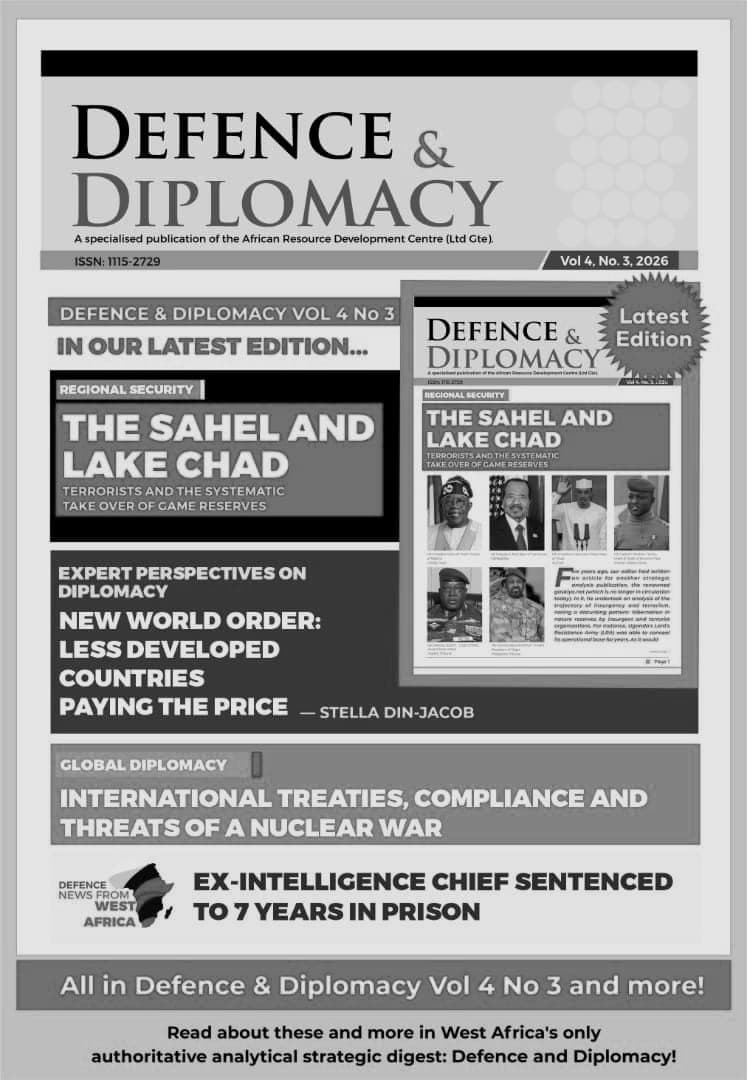
Stella Din-Jacob answers six questions on global instability, insecurity in the Sahel and Lake Chad, and the role of the media in Africa.
01The international security environment has become gravely unstable. What in your view is responsible and how can stability be returned to the global system?
The instability we have continued to witness globally stems from several factors not limited to a breakdown in multilateral trust between nations to the inability to address growing crises that breed discontent amongst restive ideologues especially the youth and a disconnect that has refused to take into consideration ‘a new world order’. The ever-dynamic media space continues to play an increasingly pivotal role in shaping narratives-regrettably, on a few occasions, the slant and dissemination of information stirs up willful misrepresentation or undertakes to control the narrative by forcing in the consciousness of the recipients without regard for the true state of what the reality of the situation may be.
When governments fail to meet the basic needs of the ordinary man on the street, the result is a silent rage which becomes a movement that is hijacked by persons, groups and faceless organisations that will in no time at all slowly but surely undermine the fabric of that society and plunge its populace into a state of utter helplessness. There has been a seismic power shift and realignment in values, principles and most of all interests since the end of the Second World war and the Cold War where a new world order has continued to redefine trust and regulate how nations especially the third world must conduct its affairs, in the course of forging new alliances, we have seen these less developed countries pay the price and become ‘fair game’ and collateral damage especially when global leaders are unable to arrive at a ‘win-win’ conclusion for all.
In today’s world, conflicts created faster than they can be solved, wars rage with reckless intensity with diplomatic efforts rendered impotent, agreements reached and broken and allies unable to act as guardrails to keep the peace and return to a state of negotiations and lasting solutions-the conflicts are too numerous to count -The war on Iran, the offensive on Palestinians and the two state solution which has continued to flounder, the long drawn out war waged by Russia on Ukraine, the guerilla wars across many parts of Africa, the drug cartels fueling and destabilizing fledgling democracies and the list is endless.
Let us focus first on Africa. Many African leaders fail to recognise that the world’s future is closely tied to the continent’s highly talented human resources. Sadly, many young people are bearing the brunt of economic and social decline and are often left with limited choices, including emigration in search of better opportunities, only to face even harsher realities abroad. During his 2009 visit to Ghana, President Barack Obama told Parliament that “Africa doesn’t need strong men; it needs strong institutions. ” He repeated this message in his 2015 address at the African Union headquarters in Addis Ababa.
His point was clear: countries can only prosper when strong structures and institutions serve citizens, uphold democratic principles, and ensure that governance does not depend solely on one leader whose personality and influence weakens or emasculates the proper functioning of laws and institutions. Today, it is the story of many countries in Africa whose nationals attempt dangerous crossings by sea or through treacherous terrains in search of a better life, we see and hear stories about women who leave West-Africa in the belief that ‘good jobs’, ‘decent pay ‘ awaits them and yet the harsh and cruel reality sets in when they realise they have been manipulated by middlemen into working as sex slaves across a number of jurisdictions from Lebanon to Oman and many more countries where ordinarily these things are either unheard of or kept under the radar.
The drug trade has seen many innocent youths, and naïve mules taking the fall for drug barons -the rise in trafficking in persons remains lucrative and appealing as some would argue that they resorted to crime and criminality because the apparatus of state failed them. The question is who failed them? And what are African states doing to reduce the brain drain even where professionals emigrate and are thriving in their chosen field outside their home countries? The continent of Africa is endowed with a pandora’s box of leaders-from the despotic to ageing and ailing statesmen and in some instances sit-tight leaders who have amassed a king’s ransom in worldly possessions.
This has continued to be the subject of discourse with many attributing Africa’s decline to be the direct result of the quality of leaders, mismanagement of the continent’s ‘commonwealth “ and the endemic corruption that again the worse critics of Africa would say is rooted in the body fabric and consciousness of those who have been entrusted to serve and those whose duty it is to ensure that the guardrails are always in place. If we look back to the end of the second world war, the Marshall plan of action focused on rebuilding economies, infrastructure and dignity of persons.
The root cause(s) of war had been dealt with and a strategic engagement to ensure that security and development went hand in glove, as the saying goes, security without development is ‘a rented peace’ and will surely expire when troops. Africa remains indebted to the First World and in the scheme of things regrettably, countries pursue interests that are strategic and beneficial. This was the case at the time the wars in Liberia and Sierra Leone raged with intense ferocity, the focus of world leaders was containing the unfolding scenario in Kosovo-their backyard as unfolding Kosovar Albanian crises could have degenerated and spread across Europe.
This was the priority for geographical as well as strategic reasons. If African governments fail to seek more investment and rely on interventions and ‘donor grants’, the continent will remain weakened by the demands that donor aid countries will levy upon countries who go cap in hand hoping for quick fixes and not lasting solutions. This perhaps explains the reason while the Mano River Union, the Former Zaire and many others in continental Africa remain in turmoil. One exception to this state of affairs may be Rwanda -but the situation remains the same elsewhere, countless peace agreements violated, half of the population decimated by war, many more displaced and the social consequences ranging from poverty, increased rate of crime, prostitution, drug abuse, ditto for countries across Eastern Europe and the former USSR where powerful oligarchs are basically functioning as cartels.what poses the biggest threat since 9-11 is the ‘radicalization many young and budding minds…we see what the dangerous ideology couched as in defence of ‘religion’(and I use this word loosely)and how it has fueled instability across borders and has in many cases bred home grown insurgents, cross border banditry and all forms of organized crime which to date, many security and intelligence agencies are yet to nip in the bud.
For as long as trust remains broken, little or no progress will be made especially where multilateral institutions have some form of leverage. Until the ‘why’ of conflict is addressed, and the ‘who’ factor is exposed, insecurity will remain a permanent feature in the ordinary course of day to day living. Just as poverty, weak justice systems and a disregard for the rules will only exacerbate the status quo.
02Why is it taking governments in the Sahel and Lake Chad States such a long time to bring insecurity to an end?
Governments from states that make up the Lake Chad and Sahel region have continued to contend with environmental factors that have (aided) the progression of the discontent from its populace. The Lake Chad as we know it today has shrunk and with this, a loss of livelihood for people who earned their income along the banks of the lake. Similarly, desertification has affected many in the same way giving rise to vulnerability and in due course, people who can be recruited by those who seek to destroy the stability and tranquility of these nations.
The breakdown in trust between the citizenry and those who are constitutionally bound to defend and protect life and property worsens further as many see a failure by governments to build institutions and create lasting opportunities. With this acting as a trigger and a ‘smoking gun’ able-bodied and economically disenfranchised persons are primed, and this makes them the ideal targets for radicalization. Beyond this, the quality of governance has seen rapid decline. Many of the states in question have seen democratically elected leaders overthrown in bloody coup d’etats and replaced by military juntas who are unable to contain or alleviate the most pressing demands of the people and the environmental challenges that aid the radicalisation process.
From Niger to Burkina Faso, this is a common denominator made worst by porous borders, endemic corruption, weak judicial systems and the absence of a common approach to eliminating the wave of insecurity across borders. The way forward must start with winning the hearts and minds of those who have been displaced economically -governments must reaffirm their commitment to improving quality of life and reconnecting with citizens as a first step to rebuilding trust and ultimately a new breed of partners who can in turn filter down the message to those who have become the tools used to destabilise the Lake Chad and Sahel States.
The Arab spring which saw the fall of Libya’s leader further destabilized the region and for a long time, many did not realise that Ghaddafi’s influence staved off several insurgent activities. Despite what many may argue as the reason for his fall from power, he was able to maintain control and contain the illegal sale of arms by non -state actors, which effectively reined in subversive activities. Ending insecurity across the Lake Chad region and Sahel States would require cooperation and coordination from all states to achieve this purpose.
Multilateral agencies must also understand the socio-economic and socio-political landscape and most of all the environmental factors that have worsened quality of life across the region. Governments on their part must renew their social contract with their citizens by rebuilding trust and delivering on campaign promises. The region has continued to see an influx of guns for hire -from combatants fleeing from across war zones to Russian mercenaries and private military companies.the Lake Chad and Sahel region must now begin to rebuild their military, invest in training and not be lured into the trap of ‘soldiers of fortune ‘whose only interest is the region’s ‘commonwealth of mineral resources’ and the lucrative contracts that are brokered with little or no consideration for the wellbeing of the citizenry.
03Media reportage of insecurity across the Sahel and Lake States has seemingly been restricted to just publishing handouts from the defense and security establishment with only few on the spot coverage on crisis areas by reporters. As someone who covered the armed conflict in Sierra Leone and Liberia what do you think has been responsible for this decline in professional first -and reportage and how can it be remedied?
Working across this region poses a clear and present danger to even the most daring and dedicated journalists in search of a story. This is compounded by several factors, including the lack of insurance, the prohibitive cost of staying with the story, the volatile nature of the terrain and the back -end support that any journalist requires to be on top of the game. Many journalists today are not equipped to undertake the reportage of crises especially conflict, investigative reporting of humanitarian disasters as they unravel.
These stems from three scenarios namely-a lack of interest, the absence of skillset and funding for this specialized reportage of events. My experience as a newsroom leader and war correspondent embedded with troops in theatres of combat has placed me in the thick of this discourse where I engaged younger colleagues and budding talent on this issue. Their answers range from little or no training, to the lack of insurance and the fear of what will happen when the inevitable does happen. Some are honest enough to reveal their apathy for serious minded reporting which begs the question -what are you in this line of business for?
Training is an integral part of journalism, just as conflict reporting and covering wars must be the focus of media organisations especially in Africa. Too many narratives are so far removed from the reality of what is happening and it begs the questions as to whether an ulterior motive exists or it is just a deliberate ploy to debase and skew public opinion. no one can tell the stories about Africa better than those who live it and see up close events as they unfold. It is time to invest in a crop of multimedia professionals who can bring stories about wars and conflict to light and repurpose the way in which information is disseminated.
04What role should the media be playing to positively influence policy in African States?
The media’s role in influencing policy across Africa is not just a civic responsibility but a constitutional one. The only way professionals in this field can play a positive role is if they first pay attention to the issues by understanding the complexities, history, rationale and so forth of the nature and complexities of the continent, the people and the emerging world order. They must come from a position of knowledge and be the watchdog of society, speaking the language of truth, accountability, probity and respect for the constitution and laws of the land how pivotal they are in recognise that they hold in trust on behalf of all Africans
05There are those who argue that for the media to play this role more effectively, the quality of its editorial resource must be high. Do you agree with this view and how would you rate the quality of editors and editorial boards in the major media organisations in Africa today?
Without a doubt, anyone in media must be on top of their game. Standards must improve, norms must be upheld and organisations must commit to training and manpower development
06Africa has no dedicated medium echoing its voice and concerns(the way Al-Jazeera speaks for the Arab world and the way BBC, Sky News, CNN etc. transmit the interests of the( Euro-Atlantic powers )Should we have one and what should it look like?
The time is indeed now for this to happen and if you remember Bayo, during my media journey which began 31 years and still counting of which our paths crossed twenty-eight years ago, I have always advocated that we must tell our own stories. I have shared the skeleton of what will be the book I will write about my coverage of the wars particularly in Liberia and Sierra Leone. My coverage of those wars were predicated by the preoccupation of the world’s greatest powers in the Kosovar Albanian humanitarian crisis.
On a scale of one to ten, the unrest in the Mano River Union Countries may have been a dismal three out of ten and was of little or no priority. Someone from this neck of the woods needed to keep the story on the front pages as opposed to making it a copy story that was drowned by the tragic events unravelling in Europe which I dare say needed to be contained and not allowed to spread outside the immediate theatre of conflict. As you rightly observed, look at the Al-Jazeera model, state owned but went after big western names to tell the story of the Arab world -this was indeed ingenuity at its height and a coup de grace of some sort.
This gave the network credibility as it was a calculated rebranding strategy but also many may argue, it lost a lot of its followers. Many now would watch that channel for balanced news coming out of the region. Sky news is unapologetically British and would on many occasions focus on home-based news first save from when a cycle of breaking news necessitates round the clock coverage. I look forward to spearheading this idea that I have incubated for a quarter of a century, it is most certainly a child of necessity and the time to birth it is NOW.